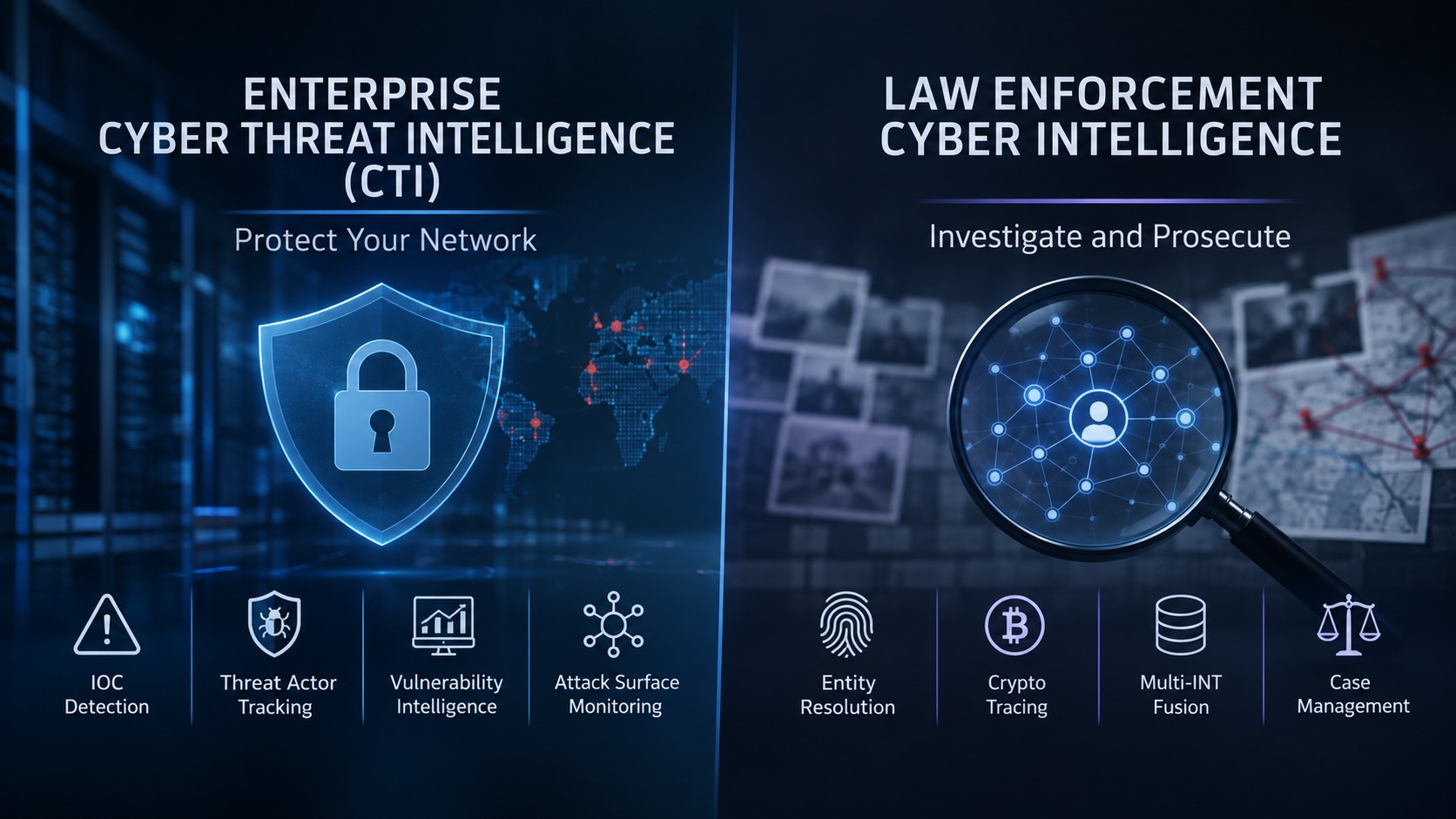
Two Different Markets That Sound the Same
"Cyber intelligence" means two fundamentally different things depending on who's asking:
Enterprise cyber threat intelligence (CTI) is what a CISO's team uses to protect corporate networks. Tools like Recorded Future, CrowdStrike, and Anomali track indicators of compromise (IOCs), monitor threat actor groups, and alert security teams when their infrastructure is being targeted. The buyer is a SOC manager or threat hunter. The output is alerts and IOC feeds.
Law enforcement cyber intelligence is what investigators use to investigate and prosecute cybercrime. It fuses OSINT, dark web monitoring, cryptocurrency tracing, communications intercepts, and case data to map criminal networks, trace proceeds, and build cases for prosecution. The buyer is a detective, analyst, or task force commander. The output is intelligence packages, evidence, and mapped networks.
These are not competing versions of the same thing. They are different tools for different buyers solving different problems. But the similar terminology creates confusion — agencies sometimes purchase enterprise CTI tools expecting them to support investigations, only to discover they were built for a completely different use case.
What Enterprise CTI Does Well
Enterprise CTI platforms are excellent at their core mission:
- IOC detection and alerting — monitoring for indicators that an organization's systems have been compromised
- Threat actor tracking — following known APT groups, ransomware gangs, and threat infrastructure
- Vulnerability intelligence — tracking CVEs and exploitable vulnerabilities relevant to the organization's tech stack
- Attack surface monitoring — detecting exposed assets, leaked credentials, and external risks
- Security operations integration — feeding threat intelligence into SIEM and SOAR platforms for automated response
For a corporate security team, these capabilities are essential. They answer: "Are we being attacked, and by whom?"
Where Enterprise CTI Falls Short for Investigations
Enterprise CTI platforms are not built for investigators. The gap becomes apparent when you examine what law enforcement and defense investigators actually need:
No Case Management or Evidence Handling
Enterprise CTI tools don't manage cases. They don't maintain chain of custody, track evidence, or produce court-admissible documentation. An investigator using a CTI platform would need a separate case management system and would manually correlate data between them.
No Entity Resolution Across Data Sources
Enterprise CTI focuses on infrastructure (IP addresses, domains, malware hashes). Law enforcement investigations focus on people — resolving identities across social media, phone records, financial transactions, and case data. CTI platforms don't do entity resolution across these non-cyber data sources.
No Cryptocurrency or Financial Tracing
Cybercrime investigations almost always involve following the money — tracing cryptocurrency payments, mapping money flows, and identifying exchange points. Enterprise CTI platforms don't include blockchain analytics or financial intelligence capabilities.
No Multi-INT Fusion
Enterprise CTI is a single-INT discipline — it fuses cyber threat data sources but doesn't correlate with communications intercepts, OSINT, surveillance imagery, or HUMINT. Investigators need all intelligence sources fused into a single picture.
No Multi-Agency Collaboration
Enterprise CTI is designed for a single organization's security team. Law enforcement investigations are inherently multi-agency — local police, HIDTA task forces, federal agencies, and international partners all need to share intelligence. CTI platforms don't support this workflow.
No Explainable AI or Audit Trails
Enterprise CTI platforms produce alerts and risk scores. They don't need to explain their reasoning to a court. Law enforcement intelligence must be explainable, auditable, and defensible — every conclusion must trace back to source data through a documented methodology.
What Law Enforcement Cyber Intelligence Provides
A purpose-built law enforcement cyber intelligence platform delivers capabilities that enterprise CTI cannot:
- Dark web monitoring for investigations — not just threat intelligence, but identifying specific criminal activity, marketplace listings, and threat actors relevant to active cases
- Cryptocurrency intelligence — tracing blockchain transactions, clustering wallets, identifying exchange points, and connecting wallet activity to known entities
- OSINT fusion — combining social media intelligence, public records, and open-source reporting with cyber intelligence data
- Entity resolution across all data sources — resolving identities across cyber, financial, communications, and open-source data
- Network mapping — constructing relationship graphs that show how cybercriminals, their infrastructure, their financial channels, and their social connections relate
- Case management and evidence handling — maintaining chain of custody, producing court-admissible documentation, and building defensible cases
- Multi-agency collaboration — secure intelligence sharing across jurisdictions and agencies
- Explainable AI with audit trails — every analytical conclusion traceable to source data
The Different Questions They Answer
The clearest way to understand the difference is to look at the questions each type of platform answers:
| Enterprise CTI asks | Law enforcement cyber intelligence asks |
|---|---|
| Is our network being attacked? | Who is behind this cybercrime network? |
| What IOCs should we block? | How are these suspects connected? |
| Which threat actor group is targeting us? | Where did the money go? |
| What vulnerabilities do we have? | Can we build a case for prosecution? |
| Are our credentials leaked? | What does the full network look like across all our data? |
Can They Coexist?
Yes. Some agencies use both:
- Enterprise CTI for protecting their own IT infrastructure
- Law enforcement cyber intelligence for investigating cybercrime
But agencies with limited budgets should prioritize based on their primary mission. If the mission is protecting networks, enterprise CTI is the right investment. If the mission is investigating and prosecuting cybercrime, a purpose-built law enforcement intelligence platform is the right investment — and repurposing an enterprise CTI tool for investigations will produce frustration, not results.
How to Evaluate the Difference
When evaluating platforms, ask three questions:
-
What is the primary output? If it's alerts and IOC feeds, it's enterprise CTI. If it's mapped networks, resolved entities, and case-ready intelligence, it's law enforcement cyber intelligence.
-
Does it handle non-cyber data sources? If the platform only ingests IP addresses, domains, and malware signatures, it's enterprise CTI. If it ingests social media, phone records, financial transactions, and case data alongside cyber data, it's law enforcement cyber intelligence.
-
Can it produce court-admissible evidence? If the platform has no chain of custody, audit trail, or evidence export capabilities, it's not built for investigations.