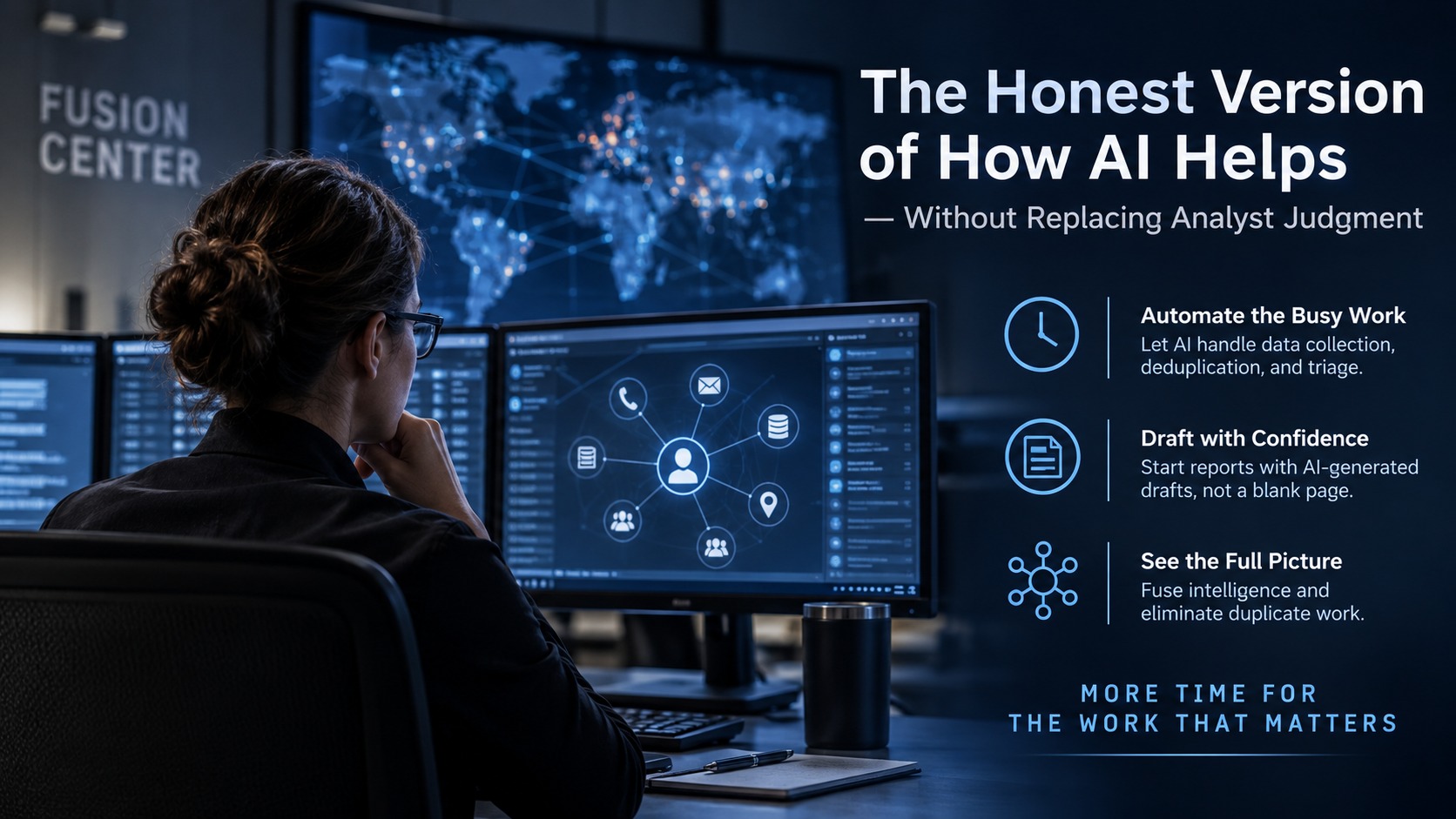
The Honest Version of How AI Helps — Without Replacing Analyst Judgment
Fusion-center analysts are asked to do an impossible job. They monitor dozens of data sources (law-enforcement records, OSINT, social media, communications metadata, watchlists, tips, partner-agency feeds), triage the resulting volume of alerts and tips, produce intelligence products on deadline, and brief stakeholders — all while operating under data-handling caveats, oversight requirements, and the inherent stress of work that touches threats to life. The predictable result is burnout: analysts leave the profession within three to five years on average, taking their training and clearance with them.
Adding headcount does not solve this. The problem is not the number of analysts; it is the volume of low-value work that consumes their attention. An analyst who spends 60 percent of their day collecting, deduplicating, and formatting data has 40 percent left for the actual intelligence work — the pattern recognition, the contextual judgment, the dissemination decisions — that they were trained for. AI applied to the low-value work, without trying to replace the high-value judgment, is the most realistic path to reducing burnout at current staffing levels.
Where AI Helps — and Where It Does Not
The honest version of this discussion acknowledges that AI cannot replace analyst judgment in fusion-center work. Threat assessment, source evaluation, and dissemination decisions require human context that current AI does not have. What AI can do, and do well, is take over the work that analysts describe as soul-destroying: collecting the same data from five sources every morning, reconciling entity records across systems, drafting the boilerplate sections of intelligence products, monitoring tip lines for duplicates and near-duplicates, and surfacing the three things in the morning queue that actually warrant analyst attention.
The right framing for a fusion-center program manager is not "AI will replace analysts" — it is "AI will let your analysts spend their day doing analyst work." That framing matters because it sets realistic expectations, avoids the political resistance that comes with replacement framing, and matches how AI actually performs in a fusion-center environment today.
Three Concrete Applications That Reduce Workload
1. AI Analyst Assistant for Query and Triage
The single highest-impact application is a secure AI analyst assistant that lets analysts query their fused data in natural language. Instead of writing SQL or navigating a complex interface, the analyst asks "what do we have on the subject of last night's tip?" and the assistant returns the resolved entity, the related records, the communications metadata, the prior tips, and the open-source profile — with citations back to source records for verification.
This collapses a 45-minute collection task into a 30-second query, and it does so inside the agency's secure network without sending data to a third-party LLM. The assistant does not make judgments. It surfaces the data the analyst needs to make judgments. That distinction is what makes the assistant safe to deploy in a fusion-center environment: the human remains in the loop on every assessment, every dissemination, and every action. See EVO Chat for the broader capability.
2. Automated Report Generation for Intelligence Products
Intelligence products — bulletins, tip reports, intelligence summaries — follow predictable structures. The factual sections (subject identification, source list, chronology, related entities) can be drafted automatically from the resolved case graph, leaving the analyst to write the assessment section that actually requires their judgment.
This is not about generating finished intelligence products; it is about generating the first draft of the boilerplate sections so the analyst starts from a draft rather than a blank page. See report assistance for the underlying capability, and the analyst workspace for where the drafts land.
The time savings compound. An analyst who produces three intelligence products a week and saves 90 minutes per product on boilerplate drafting gets back four and a half hours per week — roughly half a day, every week, that they can spend on assessment quality instead of formatting.
3. Intelligence Fusion to Eliminate Duplicate Work
The most under-recognized source of analyst burnout is duplicate work — three analysts in three different units investigating the same subject without knowing it, or one analyst re-collecting data tomorrow that a colleague collected today. A unified intelligence fusion engine that resolves entities across the agency's data sources means each subject has one canonical record that every analyst sees.
The first analyst who touches a subject builds the record; every subsequent analyst starts from that record instead of rebuilding it. This is less glamorous than an AI assistant, but it produces larger burnout reductions over time. The agency that eliminates duplicate collection work eliminates the most demoralizing form of analyst workload — the work that did not need to be done at all. See intelligence automation for the broader capability.
What This Looks Like in Practice
A realistic deployment starts with the fusion engine (eliminate duplicate work and create a single source of truth), adds the AI analyst assistant on top of the fused data (collapse collection time), and adds automated report drafting once the assistant is established (collapse product time). Each step produces measurable time savings that the program manager can use to justify the next step. None of the three steps requires replacing analyst judgment — they all preserve and elevate it.
The result is a fusion center where analysts spend their day on the work they were trained for, where junior analysts ramp up faster because they have an assistant to query, and where senior analysts stay in the profession longer because the low-value work no longer consumes their day. That is what reducing burnout actually looks like, and it is achievable with the AI capabilities that exist today — paired with a human-in-the-loop model that keeps the analyst in control of every consequential decision.
Related Reading
- Human-in-the-Loop AI
- Human-Controlled AI
- Multi-Agency Intelligence Sharing
- EVO Chat — Secure Intelligence Analyst Assistant